Belong France tracks your journey to nationality
one requirement at a time.
Your tracker stays on the phone. No account, no tracking. In English and Français.
The same tracker, the same 449 questions, the same French rules. In English and Français.
7 day free trialYour tracker stays on your phoneEvery rule dated and sourced

Android
There is no account and no tracking in Belong France. Here is exactly what that means on each phone.
The iOS app keeps your tracker on your iPhone. There is no account to create and nothing you enter leaves the device. The documents you attach are encrypted by iOS while the phone is locked and are deliberately kept out of your iPhone backup, so they never reach another device. Belong France never uploads them and never sees them.
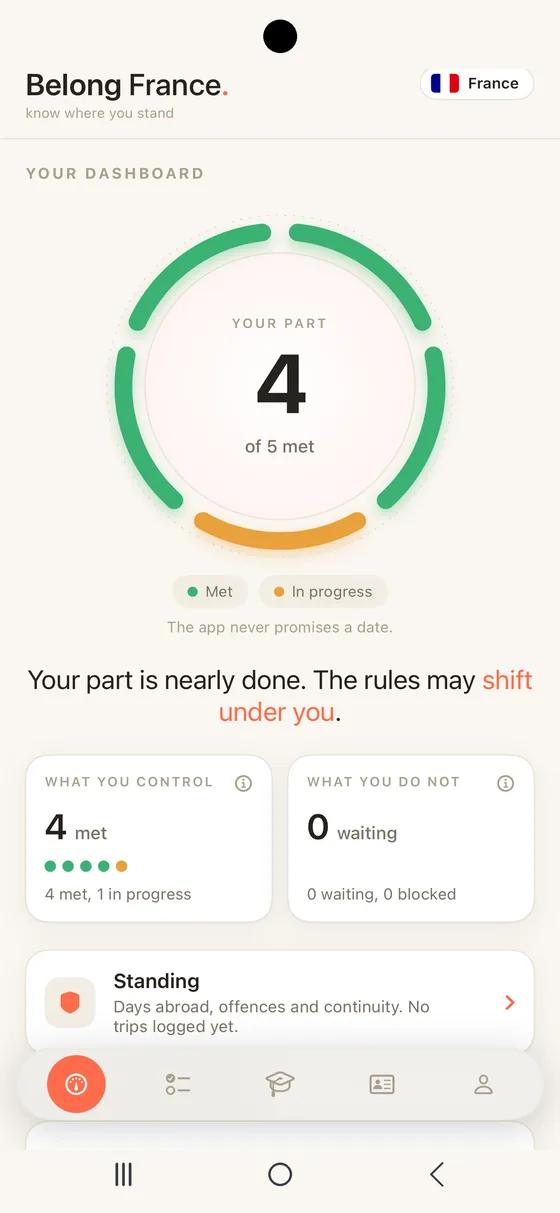
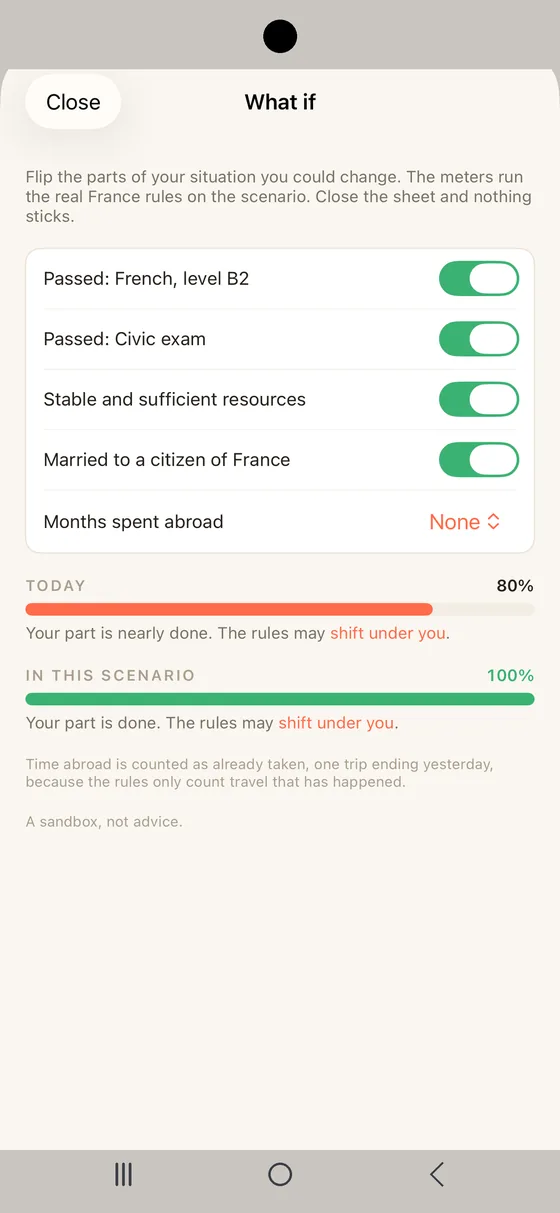
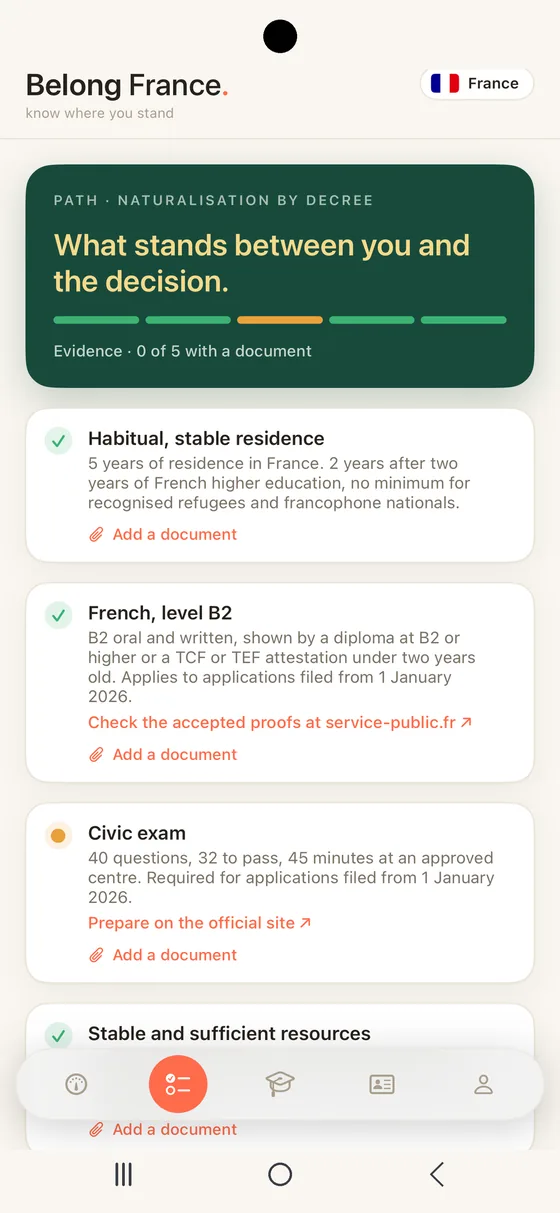
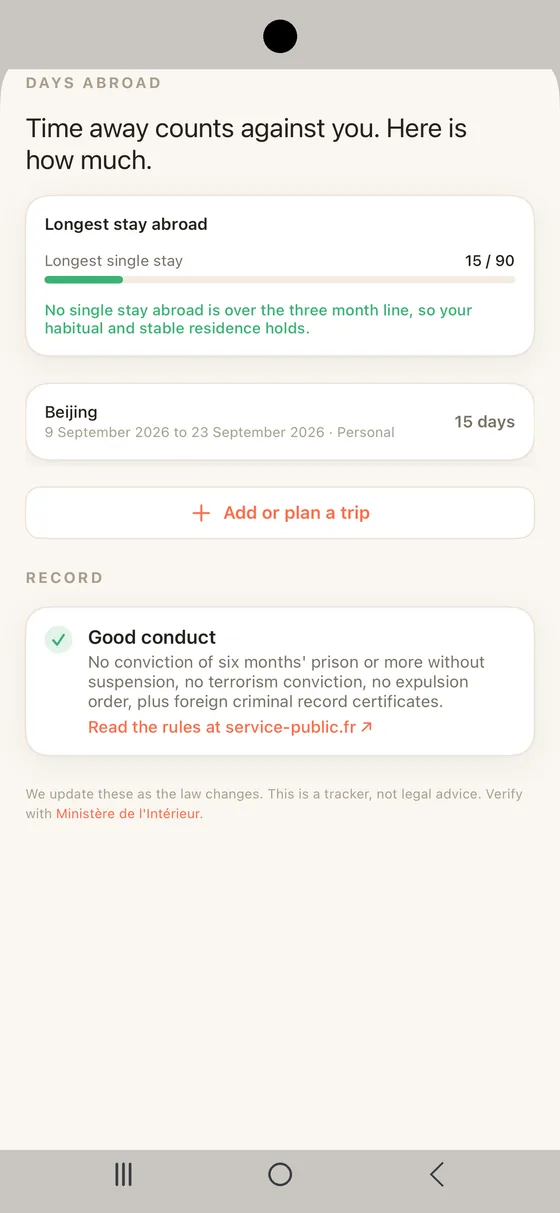
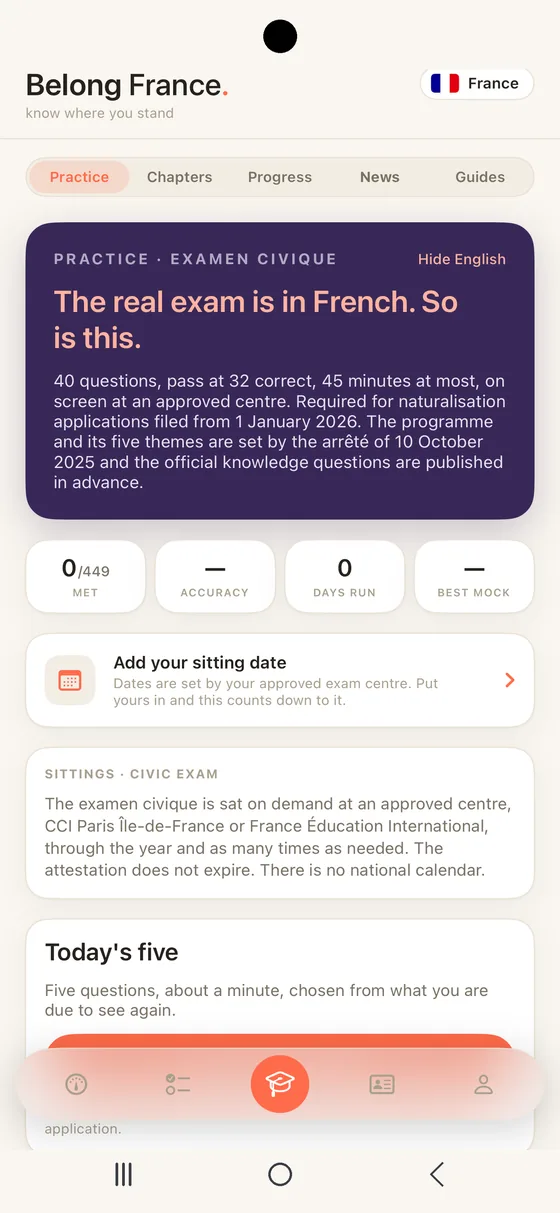
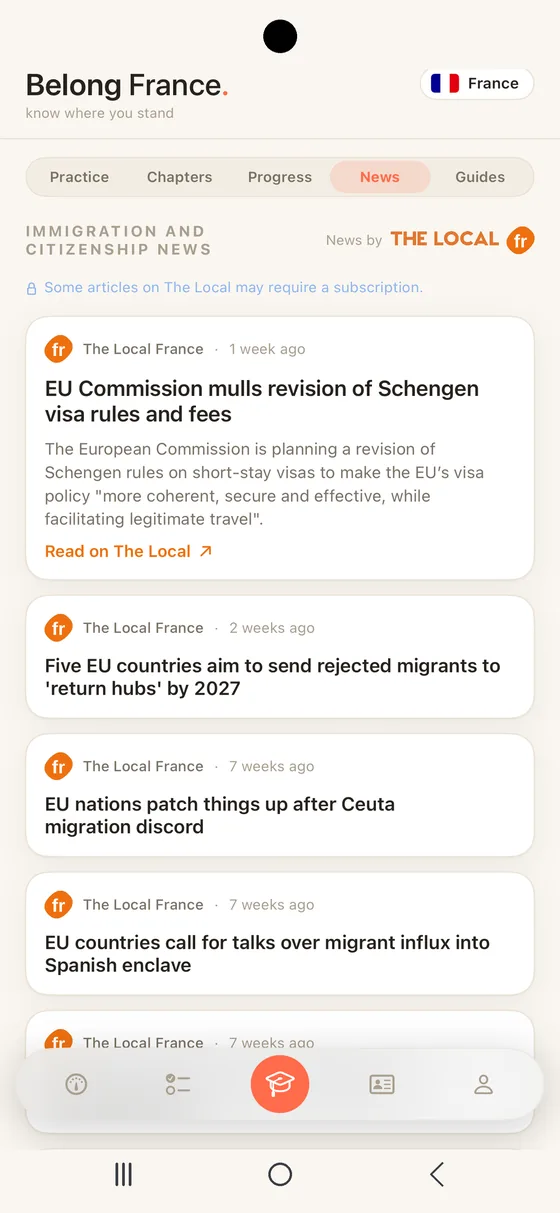
The Android app is built to the same rule: your tracker stays on the phone, with no account and no tracking, and documents in the app's own private storage rather than anywhere we can reach. It is not on Google Play yet, so nothing here is live and no link claiming to be it is ours. The screenshots on this page are the same app shown in a Galaxy's frame.
One tracker, and the same promise on either phone: what you type in stays where you typed it.
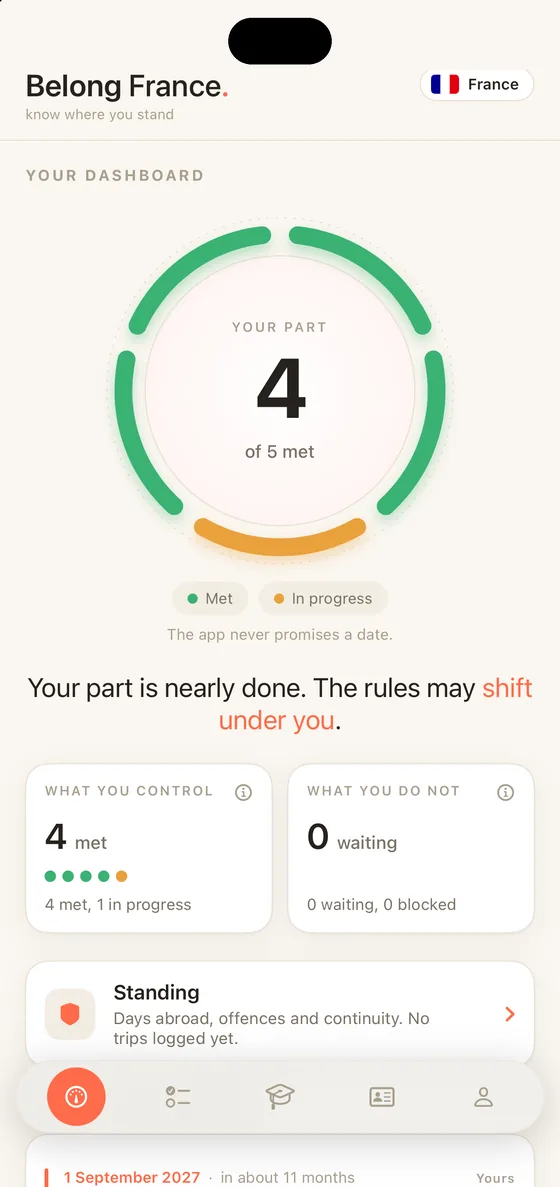
The Dashboard now opens on a ring with one segment per requirement on your route. Green is met, amber is in progress, red is blocked and the number in the middle is how many you have met. Every tab got the same treatment: one colour per tab, clear boxes and coral on the details. Out now on iPhone. On Android it arrives with the app, coming very soon to Google Play.


The Dashboard splits the journey into the part you control and the part you do not. The ring shows how close you are, one segment per requirement, green when met, amber in progress, red when blocked. The number in the middle is how many you have met. Below it Belong France lists the routes open to you: naturalisation by decree after five years of habitual residence, two years after two years of French higher education, no minimum duration for recognised refugees or francophone nationals and the declaration for the spouse of a French citizen after four years of marriage. Each carries its own status. Your prefecture instructs the file and the Ministère de l'Intérieur decides, so your route reaches a real finish line.
What's coming sits just under that split: the dates ahead of you, soonest first. The day your residence time is complete, the day after a trip ends, each year of residence as it lands, a document about to expire. Every date says whether it is yours or the authority's, and one that is only a projection says so. On either phone you can turn on alerts from the You tab and get a handful a year, with notice, never a feed.
New Every alert opens what it names. Tap a date alert and the Dashboard opens on that row. Tap the Daily 5 reminder and the round opens, with the question it quoted inside it.
The headline reads straight off the ring, so the words can never say more than the ring does, and when every requirement on your route is met the ring says so: your part is done. Standing sits on the Dashboard too, a card one tap from the ring it explains.
New After you apply. Tell the app the day you filed and the Dashboard follows the wait with you: days since filing against the 18 months the law gives the administration, 12 if you have lived in France for ten years, ANEF one tap away and the updates you log from the prefecture's letters, with a reply window that becomes a date ahead and an alert. When the deadline passes, the app says what silence means.
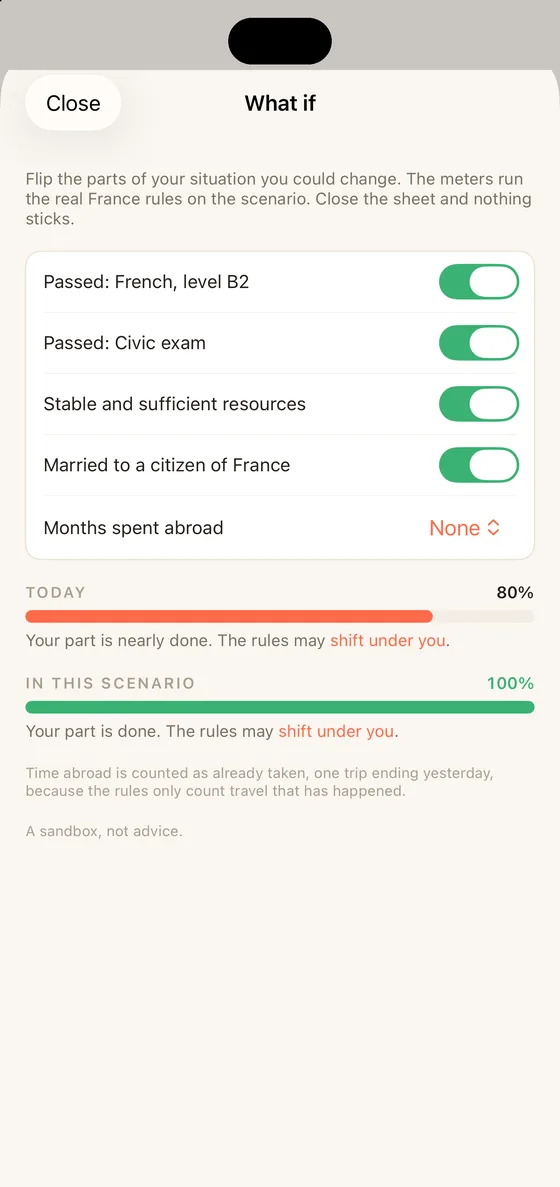
What if sits on the Dashboard and answers that without touching your file. Flip French at B2 or the examen civique to passed, add stable and sufficient resources, spend months abroad and watch your finish line move under the real French rules. It runs on a copy of your situation, so nothing you try is saved and nothing you entered changes.
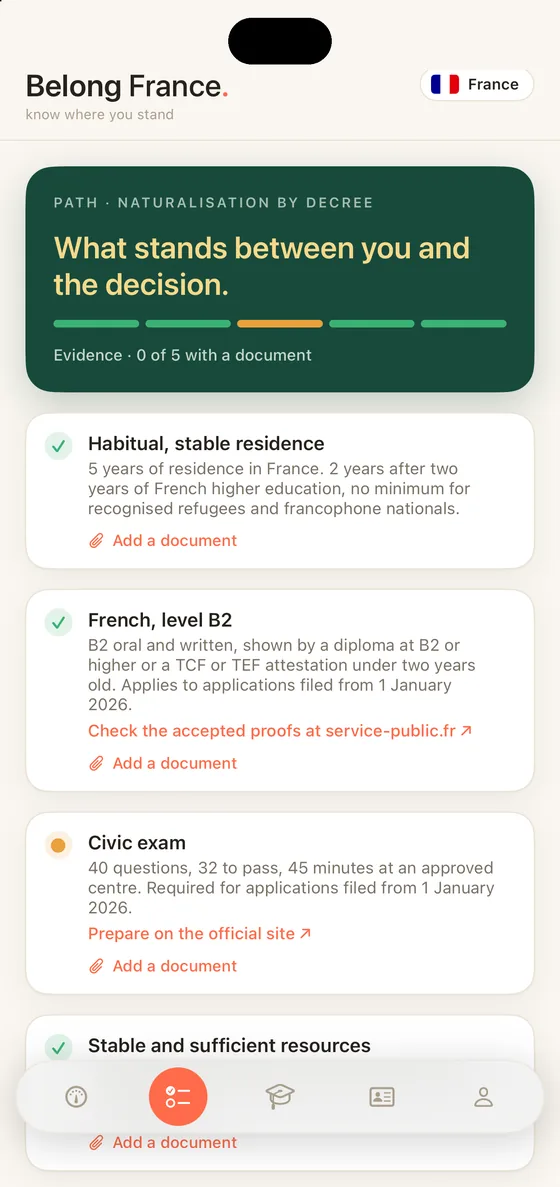
Path opens your route and lays out every requirement in order. A green tick is met and a coral dot is in progress: habitual and stable residence with France as the centre of your interests, French at B2 oral and written, the examen civique, stable and sufficient resources and good conduct. Each item explains the rule in plain language and links to the official source, service-public.gouv.fr or the Ministère de l'Intérieur. The exam facts sit here too, and the full Practice tab is one tap away.
Path is also plain about what changed on 1 January 2026. Applications filed from that date face French at B2 rather than B1, and the examen civique is now a condition of naturalisation by decree. The application fee has been 255 euros since 1 May 2026. Dual nationality is not a problem here: France asks for no renunciation, and you keep your original nationality if your own country's law allows it.
Every requirement can carry the evidence for it: a language attestation, a residence permit, a payslip, an exam result. Note when a document expires and that date joins What's coming a month ahead, so a certificate never lapses quietly while you are waiting. Documents stay on the phone you added them on. On iPhone they are encrypted by iOS while it is locked; on Android they sit in the app's own private storage. On both they are kept out of the backup, so a restored phone will not bring them back, and you should keep your own copy of anything hard to replace. Belong France never uploads them and never sees them.
The requirements as the Code civil sets them, with the two year route after French higher education, the refugee and francophone routes, the declaration by marriage and what the law does and does not say about time abroad. Dated, sourced and free to read.
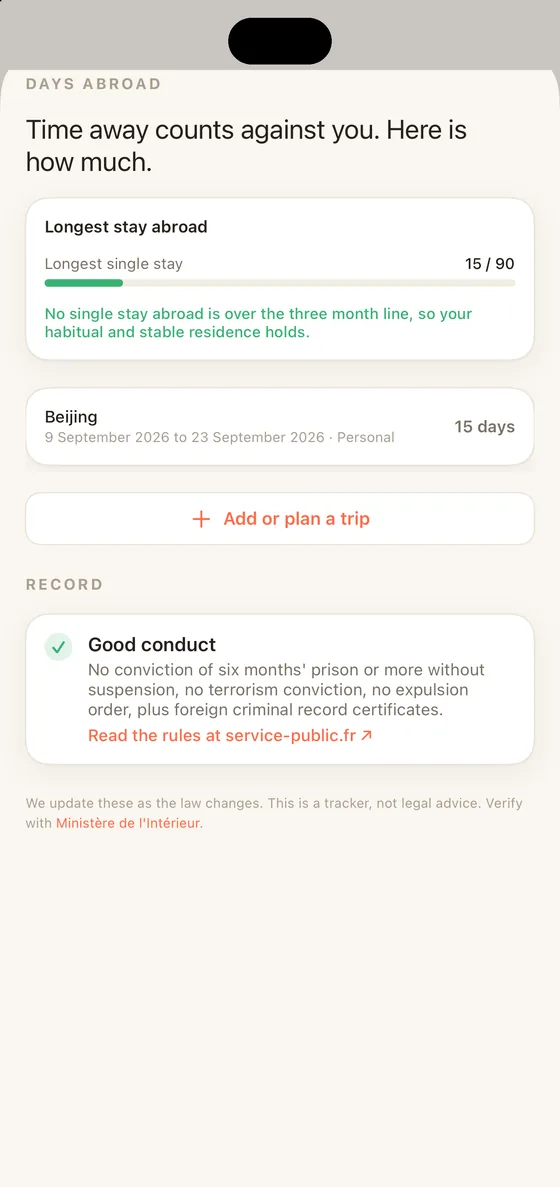
Standing watches the moving ground, your time abroad and your record. French law sets no fixed day count: residence is judged on where your home, work, family and tax life are. So Belong France measures your longest single stay abroad against a three month line, a prudence marker it sets itself, matched to the absence length practitioners report prefectures questioning. It tells you honestly when a trip could put your habitual and stable residence in question. Nothing is deducted and no legal cap is invented, because none is published. Your record sits here too, with a plain read on good conduct.
Standing lives on the Dashboard, one tap from the ring it explains: a card with your trip count opens the full view, with trips, offences and continuity all editable.
New Plan a trip before you book. Add a trip dated ahead and the trip sheet shows what the days away would do against the three month line, on a copy of the real rules. Planned trips sit in their own group, marked as planned, and count for nothing until they have happened. The day after a trip ends, What's coming asks whether the dates held.
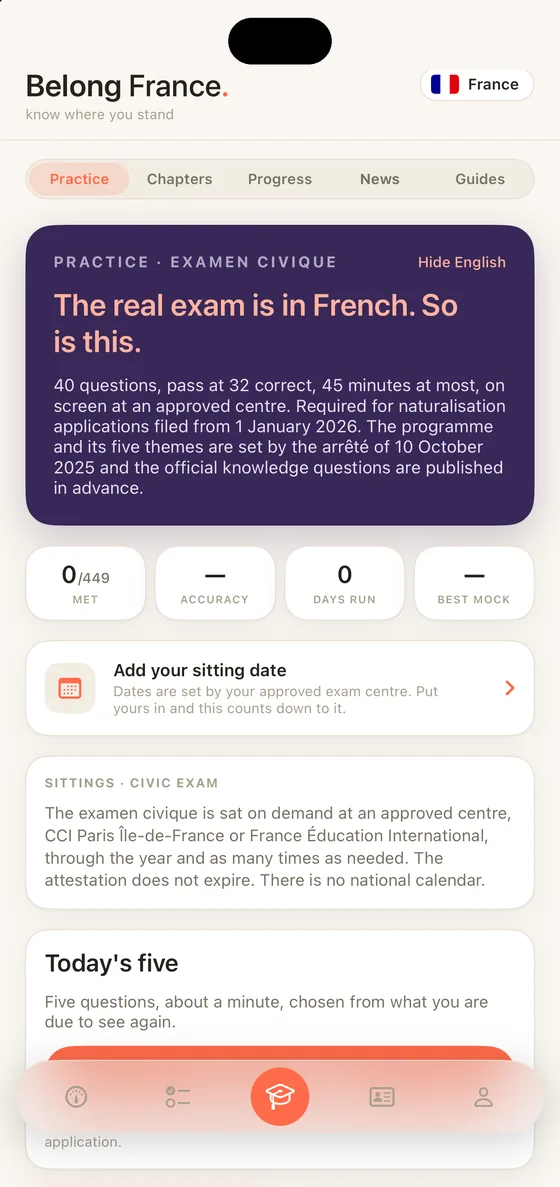
Practice trains you for the examen civique, the civic exam required for naturalisation applications filed from 1 January 2026: 40 questions, 45 minutes at most, sat on screen at an approved centre and you pass at 32. The programme and its five themes are set by the arrêté of 10 October 2025, and the official knowledge questions are published in advance.
The 449 practice questions sit in the exam's own five themes, each showing how much you hold, so you drill the theme costing you marks rather than the whole bank. They are in French, like the real exam, with an English study toggle, and the ministry's official preparation site is one tap away.
The mock is the whole paper: 40 questions in 45 minutes, in the shape the arrêté fixes, eleven on the principles and values of the Republic, six on the institutions, eleven on rights and duties, eight on history, geography and culture and four on living in French society. Because it really does ask the whole paper, it can tell you honestly whether you would pass at 32. Results are broken down by theme, with a rematch of only what you missed.
New Booking the exam. There is no national calendar: the examen civique is sat on demand at an approved centre, as many times as you need, and the attestation does not expire. The tab says so, and once you have a date, put it in and the app counts down to it.
Today's five is about a minute a day: what you get wrong comes back sooner, what you know comes back later. Practice, Chapters, Progress, News and Guides share one tab, a segment apart.
New Five guides, in the app. How the exam is built, the official material, how to register, who is exempt and what comes after, as a Guides segment in English or Français, each dated to the day its facts were checked and readable with no connection at all.
New On the iPhone, set a daily reminder and it quotes one of the questions waiting for you. Tap it and the round is already open, and once today's five are done, tonight's reminder is withdrawn.
Ten questions on the open web, in French as the real exam is set and with an English translation underneath, plus everything the ministry and the arrêté of 10 October 2025 have actually published about the exam. No account, no download.
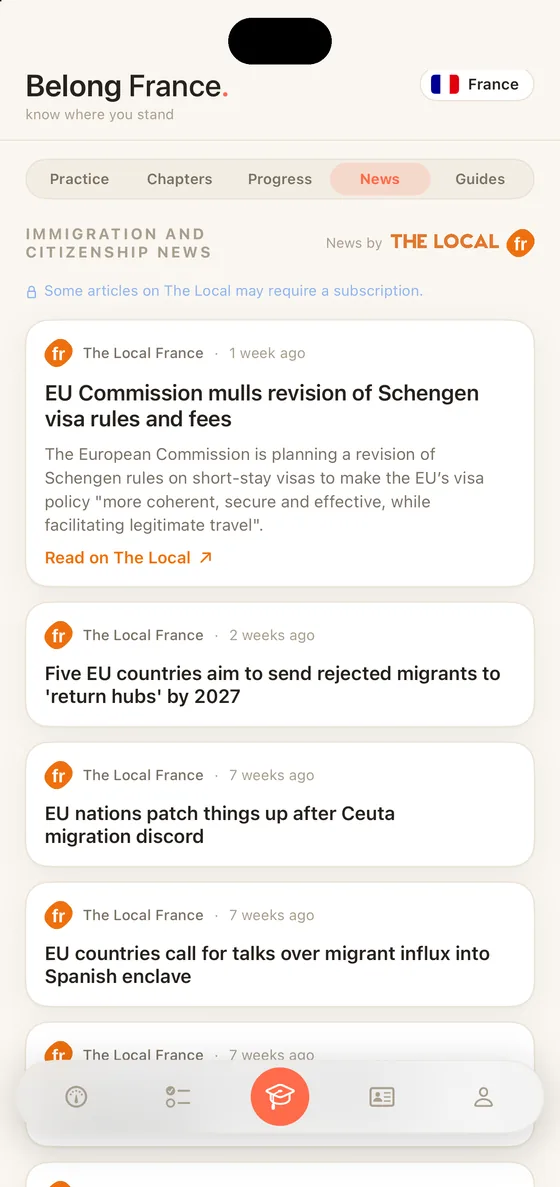
News by The Local France. The immigration and nationality news that actually affects your path, from The Local France, the English-language newspaper for France, inside the app. Two of their feeds, immigration and French citizenship, merged and newest first, so the story that changes your case is one tap away and opens without leaving the app. Turn on news alerts on the You tab and the app checks in the background and sends one quiet notification when something new is published. On iPhone a fourth widget shows the newest story on your home screen or Lock Screen. News sits as one of the five segments alongside Practice, Chapters, Progress and Guides, so what changed is never more than a tap from the drilling.
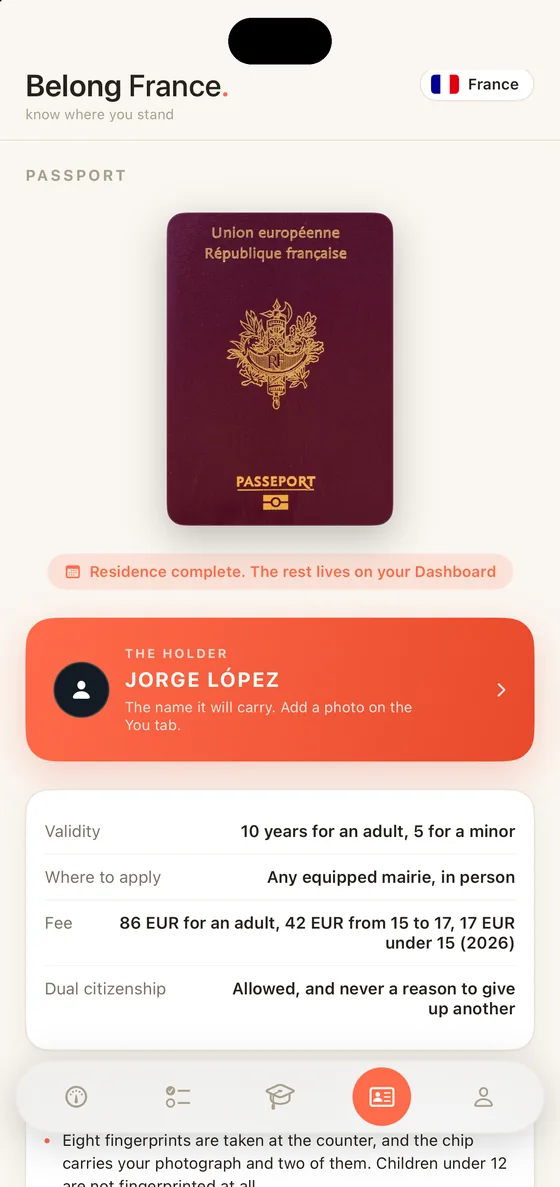
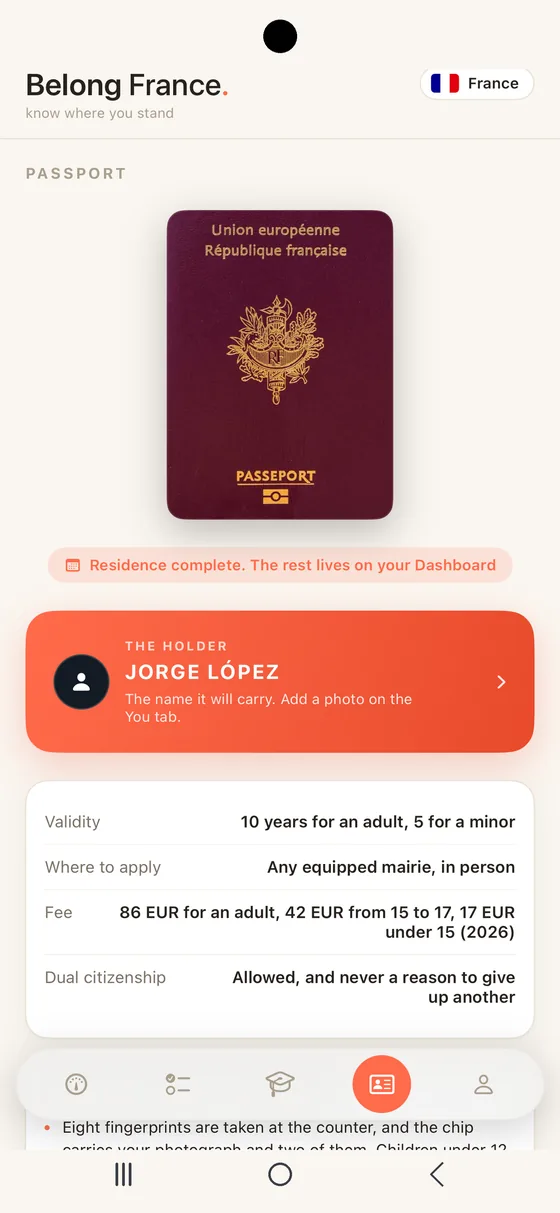
Passport is the reason for all the rest: the document your road leads to. The real cover in colour with the facts that matter beside it: validity, the fee, where you apply and dual nationality. Every figure is taken from the issuing authority's own published pages, dated and linked to the source.
Add your name and a photo and the passport carries them as the holder's. A pill under the cover says when you could apply, at the earliest, from the same figures your Dashboard reads, and the tab tells you what makes this passport particular: eight fingerprints taken at the counter, two of them stored on the chip, a 48 page grand voyageur version for constant travellers and the faisceau de licteur on the cover, which looks official and is not, because the Republic has no coat of arms. Valid ten years for an adult and five for a minor, 86 euros for an adult, applied for in person at any mairie fitted with a station. France asks you to give up nothing.
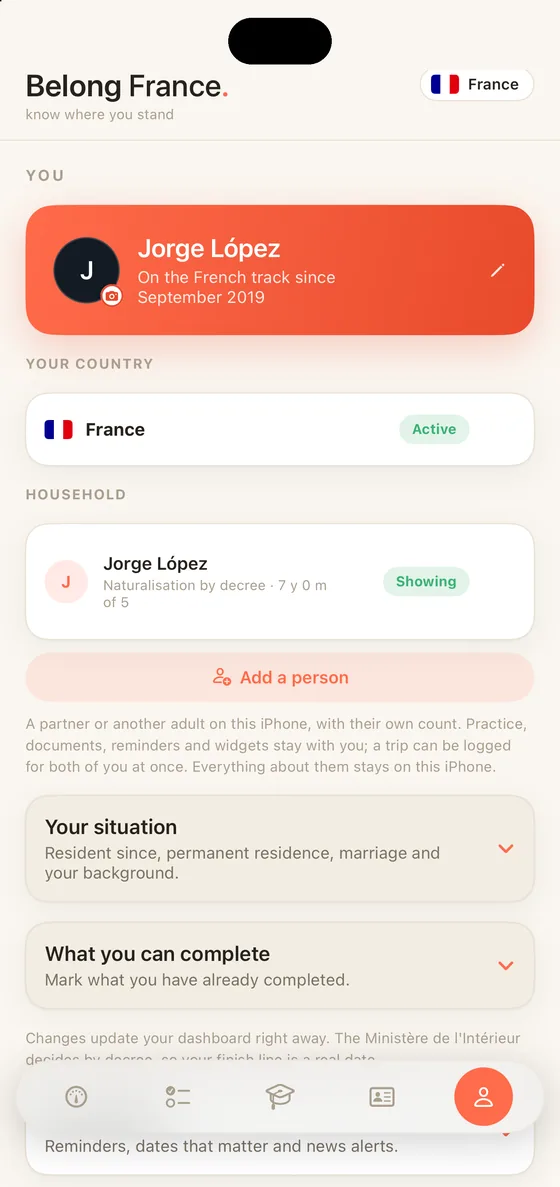
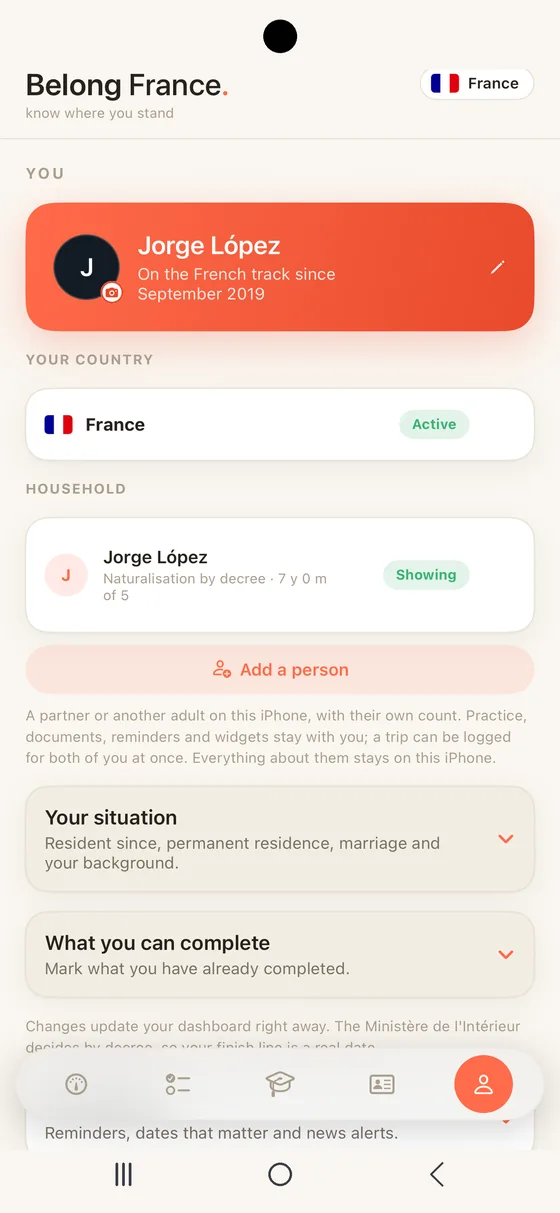
You is where every number comes from. Set the month you became resident and a short list of honest toggles: permanent residence, marriage to a French citizen, your citizenship background, French at B2, the examen civique and stable resources. Change one and the Dashboard updates right away. Your name lives here too, and a photo of you, and the Passport tab carries them as the holder's; both stay on the phone. The whole app in English or Français is one tap here, and the legal disclaimer closes the tab, because Belong France tracks the rules but does not give legal advice.
New On your home screen. Four iPhone widgets, for the home screen and the Lock Screen: your residence time so far, your longest stay abroad against the three month line, whether today's five is done and the newest story from The Local. The same numbers the app shows, run through the same rules, and nothing leaves your iPhone. Setting up now ends with your name and the reminders you want, all optional.
New A second person on the same iPhone. Add your partner, or another adult, under Household and they get their own count, with their route, their years and their trips. Switch between you from the same card, and the header says whose count is on screen. A trip you took together is logged once and counted for both of you. Practice, documents, reminders and widgets stay with you, the phone's owner, and everything about the second person stays on the phone, like everything else here.